
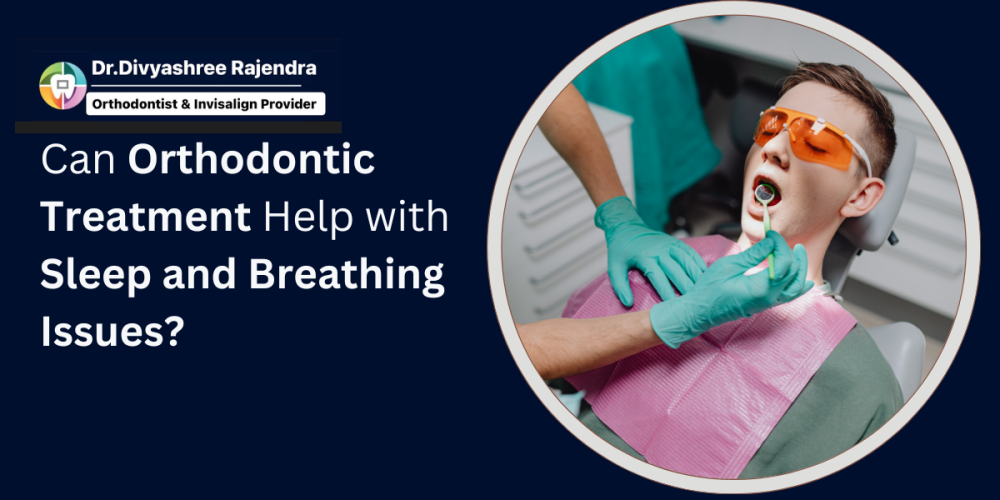
What if the reason behind poor sleep is not your mattress or stress but the way your jaws and teeth are positioned?
Increasingly, orthodontics for breathing problems is gaining attention because airway development, jaw structure, and dental alignment are closely connected. At Dr. Divyashree Rajendra’s Orthodontics, patients often discover that correcting dental and skeletal issues can contribute to better breathing, improved sleep quality, and enhanced overall health. As a result, orthodontics for breathing problems is becoming an important part of supporting both oral health and overall well-being.

How Are Sleep and Breathing Connected to Orthodontics?
Many people associate orthodontic treatment only with straighter teeth. However, orthodontists also evaluate how the teeth, jaws, tongue, and airway function together to support overall health.
When the upper or lower jaw develops improperly, it can reduce the available space for the tongue and airway. As a result, this restriction may contribute to breathing difficulties during sleep, snoring, and even certain forms of sleep-disordered breathing.
The Role of Jaw Development
The jaws form the framework that supports the airway. Therefore, when they are narrow, recessed, or improperly positioned, the airway may become smaller than ideal.
Common concerns associated with poor jaw development include:
- Mouth breathing
- Snoring
- Restless sleep
- Daytime fatigue
- Difficulty concentrating
- Sleep-disordered breathing
These symptoms often indicate underlying structural concerns that may benefit from orthodontics for breathing problems and early intervention.
Crowded teeth are often a sign that the jaws have not developed enough space. Consequently, this lack of space can affect tongue posture and airway dimensions.
In many cases, orthodontic treatment addresses both dental alignment and functional concerns, creating opportunities for airway improvement and better long-term oral health.
Can Orthodontics for Breathing Problems Improve Airway Function?
Orthodontic treatment cannot cure every breathing disorder, but it can play a valuable role in improving airway anatomy in suitable patients. Therefore, orthodontics for breathing problems is often considered as part of a broader treatment approach.
The goal is to create a healthier relationship between the teeth, jaws, tongue, and airway. As a result, patients may experience meaningful airway improvement and enhanced breathing function.
Expanding Narrow Dental Arches
A narrow upper jaw can reduce nasal airflow and limit tongue space. Consequently, restricted arch development may contribute to breathing challenges over time.
Orthodontic expansion techniques may:
- Increase arch width
- Create additional tongue space
- Support nasal breathing
- Promote better airway function
This approach is often considered in growing children, where skeletal development can still be influenced. Therefore, early intervention may support long-term airway improvement and healthier growth patterns.
Improving Tongue Position
The tongue should naturally rest against the roof of the mouth. However, when dental arches are narrow, the tongue may sit lower in the mouth and contribute to airway obstruction during sleep.
Orthodontic treatment can help create adequate room for proper tongue posture, thereby supporting long-term airway improvement and better breathing efficiency.
Enhancing Facial Growth Patterns
Early orthodontic intervention can guide jaw growth in children who exhibit mouth breathing or developing airway concerns. In addition, this approach may help create a more balanced relationship between facial structures and the airway.
By encouraging balanced facial development, orthodontists may help reduce structural factors associated with breathing difficulties later in life.
Can Bite Correction Help People with Sleep Apnea?
Not all sleep apnea cases require the same treatment approach. However, dental and skeletal factors often play a significant role in airway health and sleep quality.
For selected patients, bite correction can become an important part of comprehensive care. As a result, treatment may help address structural factors that contribute to breathing difficulties during sleep.
Understanding Obstructive Sleep Apnea
Obstructive Sleep Apnea (OSA) occurs when the airway repeatedly narrows or collapses during sleep. Consequently, oxygen flow may be interrupted multiple times throughout the night.
Symptoms may include:
- Loud snoring
- Gasping during sleep
- Morning headaches
- Excessive daytime sleepiness
- Poor concentration
How Jaw Position Affects the Airway
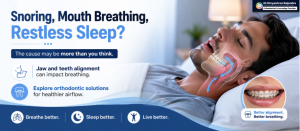
A retruded lower jaw can push the tongue backward, thereby reducing available airway space. As a result, breathing may become more restricted during sleep.
When orthodontic treatment improves jaw alignment, the tongue and surrounding tissues may have more room, potentially supporting better airflow and successful bite correction outcomes.
Sleep Apnea Dental Treatment Options
Orthodontists often collaborate with sleep physicians to provide comprehensive care. Therefore, sleep apnea dental treatment may involve multiple approaches depending on the patient’s condition and anatomy.
Depending on the patient’s needs, treatment may include:
- Orthodontic expansion
- Functional appliances
- Growth modification in children
- Orthognathic treatment planning
- Oral appliance therapy referrals
While sleep apnea dental treatment is not suitable for every patient, it can be highly beneficial when airway anatomy contributes to the condition. Consequently, a personalized evaluation is essential to determine the most appropriate treatment pathway.
Wondering whether your jaw structure is affecting your sleep?
Schedule a consultation and receive a personalized airway assessment from our orthodontic experts.
Which Orthodontic Treatments Can Support Better Breathing?
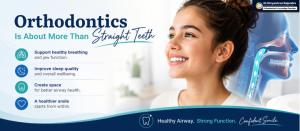
Different treatment options may be recommended depending on a patient’s age, growth stage, and underlying structural concerns. Therefore, a customized evaluation is always essential to determine the most appropriate approach.
Invisalign offers a discreet way to align teeth while improving overall dental function. In addition, at Dr. Divyashree Rajendra’s Orthodontics, Invisalign treatment is frequently used to address alignment concerns while supporting broader goals related to oral health, jaw alignment, and function.
Damon braces use self-ligating technology and specialized wires to encourage broader dental arches. As a result, they may support both orthodontic efficiency and long-term oral health.
Benefits may include:
- Improved dental arch development
- Greater comfort
- Fewer appointments
- Enhanced smile aesthetics
In certain patients, broader arches may contribute positively to airway-related considerations and support overall airway improvement.
Traditional orthodontic systems remain highly effective for correcting:
- Crowding
- Spacing
- Crossbites
- Deep bites
- Overbites
Proper bite correction often improves how the jaws function together and support overall oral health. Additionally, improved bite correction may contribute to better jaw alignment and long-term functional stability.
Growth Modification Appliances
For children, specialized appliances may help guide jaw growth during developmental years. Consequently, early intervention can be particularly valuable when breathing concerns are linked to skeletal development.
By encouraging balanced growth, these appliances may support airway improvement and healthier facial development over time.
Why Choose Dr. Divyashree Rajendra’s Orthodontics for Airway-Focused Orthodontic Care?
Successful treatment requires both clinical expertise and a deep understanding of modern orthodontic advancements. Dr. Divyashree Rajendra brings more than 15 years of experience in orthodontics and is internationally recognized for her expertise in clear aligner therapy. A gold medalist from RGUHS and a certified Invisalign Diamond Provider, she has successfully treated over 1,000 aligner patients.
Furthermore, her advanced training in Germany, Thailand, and other international programs allows her to deliver personalized treatment solutions tailored to each patient’s needs. As a Key Opinion Leader, Clinical Speaker, and Trainer for Invisalign India, she remains at the forefront of orthodontic innovation.
As a result, patients benefit from comprehensive care focused on jaw alignment, airway improvement, sleep apnea dental treatment considerations, and long-term oral health outcomes.
Wrapping Up
Orthodontic treatment is about much more than straight teeth. In many cases, orthodontics for breathing problems can help address structural concerns involving the jaws, dental arches, and airway while supporting overall function.
Key Takeaways
- Jaw development and airway health are closely connected.
- Proper bite correction and jaw alignment may support healthier breathing patterns.
- Early diagnosis can create opportunities for long-term airway improvement and better sleep quality.
- In appropriate cases, orthodontics for breathing problems and sleep apnea dental treatment planning may play an important role in comprehensive care.
Take the first step toward better sleep, breathing, and confidence.
Book your consultation with Dr. Divyashree Rajendra’s Orthodontics today.
FAQs
1. Can orthodontic treatment completely cure sleep apnea?
No. Sleep apnea has multiple causes. However, orthodontic treatment may improve airway anatomy and contribute to a broader treatment plan when structural factors are involved.
2. At what age should a child be evaluated for breathing-related orthodontic concerns?
Many orthodontists recommend an evaluation by age seven. Early assessment helps identify jaw growth patterns and airway concerns before they become more significant.
3. Is Invisalign useful for patients with breathing issues?
Invisalign primarily straightens teeth, but when incorporated into a comprehensive treatment plan, it can support functional improvements related to bite and jaw positioning.
4. How do I know if my breathing problem is related to my jaw structure?
Signs may include chronic mouth breathing, snoring, crowded teeth, a recessed chin, or sleep disturbances. A detailed orthodontic evaluation can determine whether jaw structure is contributing to the issue.